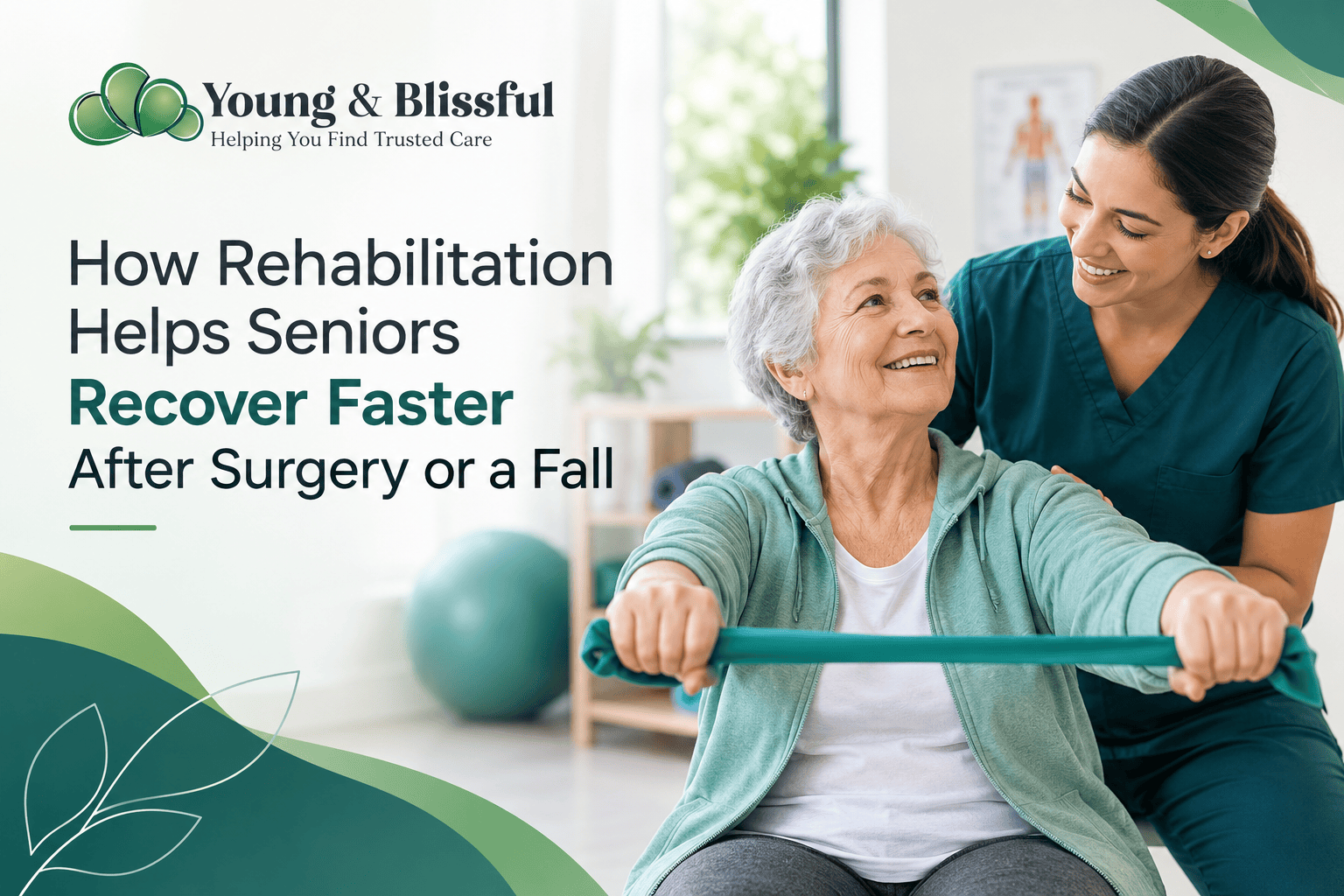
How Rehabilitation Helps Seniors Recover Faster After Surgery or a Fall is a question many families supporting an older adult after surgery or a fall ask when they want a safer, clearer next step. In Ontario, the right answer usually depends on the senior’s daily routines, mobility, health, comfort, budget, and support system. Families can use Young & Blissful as a starting point to compare rehabilitation support options by category and location across Ontario.
Quick Answer
- Senior rehabilitation after surgery or a fall is easiest to compare when families first define the real daily-life problem.
- The right option depends on fit, clarity, location, and communication — not just price.
- Ontario families usually benefit from comparing two or three realistic options before deciding.
- Support may be worth exploring when recovery, safe movement, and rebuilding routines begins to affect routines, safety, or caregiver stress.
- Young & Blissful can help families explore physiotherapy & occupational therapy options across Ontario with more clarity.
What is senior rehabilitation after surgery or a fall?
Senior rehabilitation after surgery or a fall refers to supports, services, products, or planning steps that may help seniors and caregivers manage recovery, safe movement, and rebuilding routines. The best fit depends on the older adult’s goals, the level of support needed, and whether the family is comparing in-home, clinic-based, community-based, or virtual options.
Why does senior rehabilitation after surgery or a fall matter for seniors and caregivers?
This topic matters because small changes in recovery, safe movement, and rebuilding routines often affect more than one part of life. A practical challenge can quickly influence safety, independence, scheduling, and caregiver stress.
For Ontario families, decisions are rarely about one service in isolation. Families often need to compare what may help now, what may help later, and how different supports work together.
Clear information can reduce rushed decisions. When families understand the main decision factors before they contact providers, they often ask better questions and choose options with more confidence.
Signs It May Be Time to Consider Support
Families often notice changes in routine before they know exactly what category to search. Support may be worth exploring when the issue is becoming more noticeable, more frequent, or more stressful.
- Changes in recovery, safe movement, and rebuilding routines are affecting day-to-day routines.
- Appointments, errands, or home tasks are becoming harder to manage.
- A senior is avoiding activities they used to handle more easily.
- Caregiver time or stress is increasing.
- Safety, consistency, or confidence feels less stable than before.
- The family is unsure which support category to compare first.
- A recent change in health, housing, mobility, or routine has created new questions.
What Are the Benefits or Reasons to Consider This Service?
The main value of exploring senior rehabilitation after surgery or a fall is clarity. Families can better understand which options may support safety, independence, comfort, and coordination.
The right support may help with mobility, balance, strength, pain, home safety, and recovery after illness, injury, or surgery. Even when the benefit is gradual, practical improvements can reduce daily friction for both seniors and caregivers.
Comparing providers or solutions early may also help families avoid rushed decisions, unnecessary duplication, or support that does not match the senior’s actual needs.
How Does It Work?
- Start by naming the main concern in plain language.
- Decide whether the need is immediate, short-term, or ongoing, and whether physiotherapy & occupational therapy is the best category to compare first.
- Make a short list of local options and note what each one includes.
- Ask about availability, location, service model, pricing transparency, and experience with older adults.
- Use a first call, consultation, tour, or product discussion to clarify fit.
- Review whether the option feels practical, respectful, and appropriate for the senior’s real routine.
How to Choose the Right Provider in Ontario
- Location and service area
- Experience serving seniors and caregivers
- Clarity about what is included
- Accessibility, safety, and comfort
- Communication quality and responsiveness
- Whether the option can adapt as needs change
How to Compare Providers Before You Contact Them
| Factor | Why it matters | What to ask |
| Service area | Families need to know whether support is actually available where the senior lives | Do you serve this city or region? |
| Fit for seniors | Older adults often need different pacing, setup, or communication | Do you work with older adults regularly? |
| Service model | The best option may depend on whether support is in-home, on-site, or remote | Do you offer in-home, clinic, or hybrid support? |
| Practical planning | Clear expectations reduce confusion later | What happens after the first appointment, visit, or purchase? |
| Family involvement | Adult children and caregivers are often part of planning | Can caregivers be included in communication and decisions? |
| Quality of explanation | A good provider helps families understand next steps | How do you measure progress for seniors? |
Costs and Considerations
Costs vary by provider, location, urgency, frequency, and what is included.
Some services, devices, or consultations may be partly covered through private benefits, workplace plans, or other funding sources depending on the situation.
Families may want to confirm current pricing, coverage, cancellation terms, and reimbursement rules directly with the provider and current Ontario resources where relevant.
Tips for Seniors and Caregivers
- Write down the main problem before contacting providers.
- Include the senior’s own priorities whenever possible.
- Ask what is included, not just what the service is called.
- Compare two or three options instead of choosing the first one too quickly.
- Keep notes in one place so family members can review them together.
- Ask whether the provider has experience with recovery, safe movement, and rebuilding routines in older adults.
- Review fit after the first interaction rather than assuming the first option must be final.
Common Mistakes to Avoid
- Waiting until the situation feels urgent
- Choosing only by price without checking fit
- Not confirming service area or accessibility
- Assuming all providers offer the same level of support
- Not involving the senior in the decision when possible
- Skipping practical questions about scheduling, follow-up, or communication
PROVIDER CHECKLIST
- Does this option serve the senior’s location in Ontario?
- Is the service or product clearly explained?
- Does it match the senior’s actual routine and support level?
- Are costs and next steps easy to understand?
- Is the provider experienced with seniors or caregivers?
- Can family members be included in planning or communication if needed?
RELATED SERVICES TO EXPLORE ON YOUNG & BLISSFUL
Mobility & Accessibility: may be helpful when the family needs adjacent support in addition to physiotherapy & occupational therapy.
Home Care & Personal Support: may be helpful if the main challenge affects more than one area of daily life.
Transportation: may be helpful when caregiver planning, safety, or coordination is becoming more important.
FAQS
What is senior rehabilitation after surgery or a fall?
Senior rehabilitation after surgery or a fall is a broad term for support that may help seniors and caregivers manage recovery, safe movement, and rebuilding routines. The best choice depends on the older adult’s needs, location, and goals.
How much does rehabilitation support cost in Ontario?
Costs can vary widely by provider, location, visit type, urgency, and what is included. Families usually need to confirm current pricing directly with the provider.
How do I find rehabilitation support near me?
A practical starting point is to compare providers by category and location. Young & Blissful can help families explore local options across Ontario.
What should I ask before choosing a provider?
Families often ask about experience with seniors, service area, what is included, availability, communication, pricing, and whether caregivers can be involved.
When should a senior consider rehabilitation support?
Support may be worth exploring when recovery, safe movement, and rebuilding routines begins to affect safety, independence, routines, appointments, or caregiver stress.
Do Ontario location and access matter when comparing options?
Yes. Service availability can differ across places such as Mississauga, Hamilton, Whitby, and some options are more practical in certain communities than others.
KEY TAKEAWAYS
- Senior rehabilitation after surgery or a fall is easiest to compare when families first define the real daily-life problem.
- The right option depends on fit, clarity, location, and communication — not just price.
- Ontario families usually benefit from comparing two or three realistic options before deciding.
- Support may be worth exploring when recovery, safe movement, and rebuilding routines begins to affect routines, safety, or caregiver stress.
- Young & Blissful can help families explore physiotherapy & occupational therapy options across Ontario with more clarity.
CONCLUSION + SOFT CTA
Families usually make stronger decisions when they understand what to compare before they start calling around. Whether the next step is a provider, a product, a program, or a planning conversation, Young & Blissful can help families explore physiotherapy & occupational therapy options by category and location across Ontario.