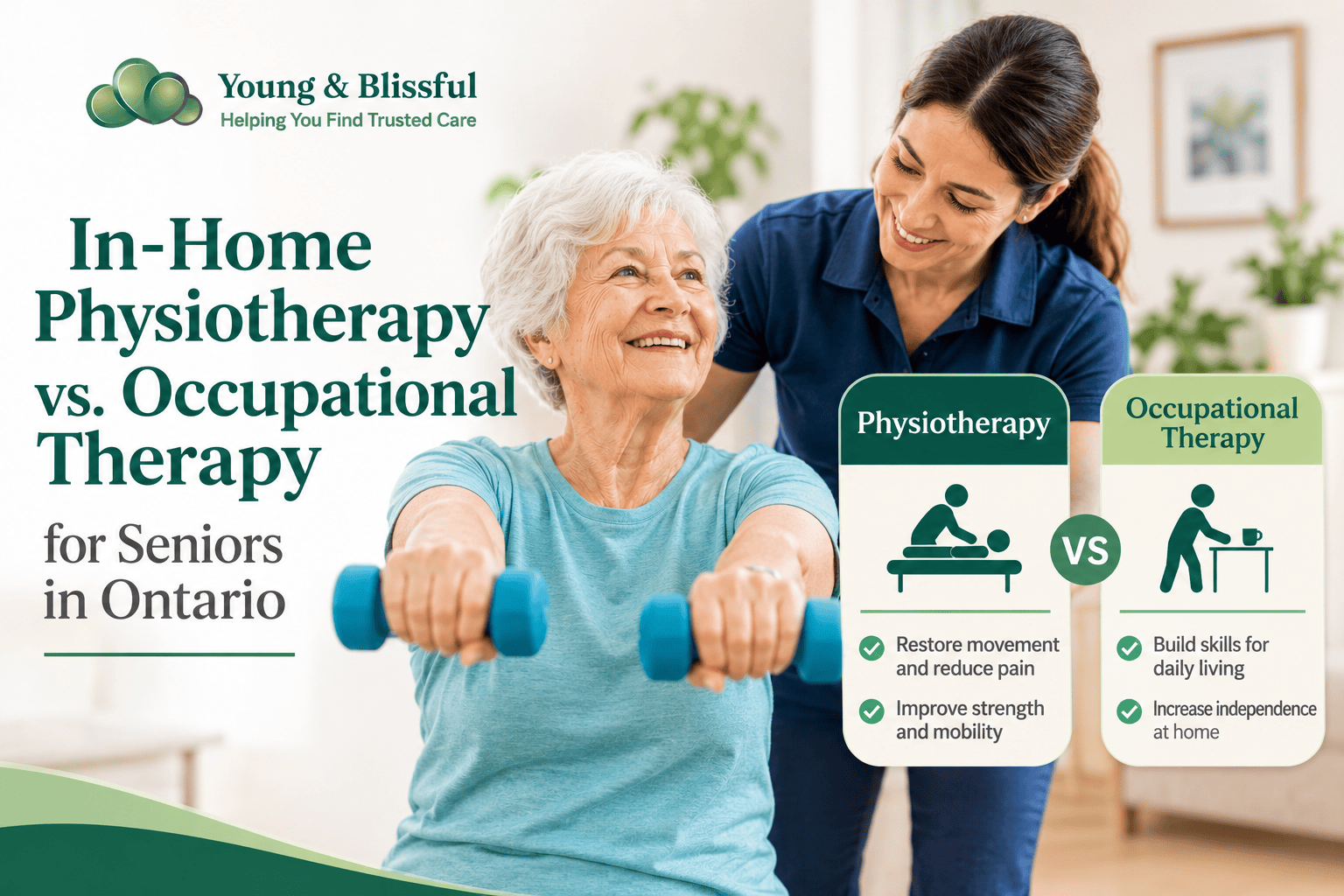
After a fall, one family asks for “physio at home” because their mother is walking more slowly. Another wants help because their father can walk but cannot manage the tub or prepare lunch safely. These sound like similar requests, yet they point to different professional expertise. Physiotherapists (PTs) focus heavily on movement, physical rehabilitation and mobility. Occupational therapists (OTs) examine how someone manages meaningful daily activities, the environment and practical adaptations. Both can be valuable; for some seniors, they work best together.
Quick answer: PT or OT at home?
- Physiotherapy: Consider it when walking, balance, strength, pain or movement after illness or surgery is the central issue.
- Occupational therapy: Consider it when bathing, dressing, cooking, transfers, equipment setup, home layout or daily independence is the main concern.
- Both: They may collaborate after a fall, stroke, hospital stay or major decline in function.
- Ontario coverage: Some people qualify for publicly funded physiotherapy or home/community care services; eligibility depends on the program and assessment.
The easiest way to tell the difference
Picture an older adult who cannot get from the living room to the kitchen without feeling unsteady. A physiotherapist may assess gait, balance, strength and a graduated movement plan. Now picture that same person struggling to use the stove, reach shelves, enter the bathtub or manage a walker in a crowded hallway. An occupational therapist may look at tasks, routines, equipment and changes to the environment. They may overlap, but their questions begin in different places.
The College of Physiotherapists of Ontario describes physiotherapy as supporting movement, rehabilitation, function and well-being. The College of Occupational Therapists of Ontario describes OT as supporting people’s ability to take part in activities that matter in daily life. These professional definitions are more useful than reducing PT to “exercise” and OT to “gadgets.” Both professions assess and make individualized recommendations within their scopes.
Why home visits can change the assessment
A clinic can evaluate movement, but a home visit may reveal important details: a narrow bathroom doorway, stairs without a suitable handrail, an uneven entrance, poorly placed seating, or long walks between the bed and washroom. The home environment matters especially when a person manages reasonably well under supervision but struggles during ordinary routines.
For physiotherapy, home treatment may include movement practice in the actual space, such as stairs or safe transfers, where appropriate. For occupational therapy, the home becomes part of the assessment: the therapist may observe how everyday tasks are performed and whether adaptations or routines could reduce difficulty. An in-home service is not automatically better for everyone. Consider access, cost, safety and whether the professional’s equipment or a clinic setting is needed.
When physiotherapy may be the better first call
Physiotherapy may be appropriate when the primary concern is reduced mobility after an illness, a fall, hospitalization or a procedure, or when pain and weakness are limiting movement. A physiotherapist can assess function and develop an individualized rehabilitation plan. The aim is not to promise that a senior will never fall again; it is to identify physical limitations and work on realistic mobility goals.
Ask how the therapist will measure progress. Can the person walk safely from bedroom to bathroom? Get up from a chair more confidently? Manage steps with an appropriate aid? Progress measures should reflect what the senior actually wants to do, not just a number on a workout sheet.
When occupational therapy may be the better first call
An OT may be a strong starting point when the difficulty is tied to specific activities or the environment: bathing, toileting, dressing, meal preparation, setting up a routine, safely entering the home or managing daily tasks after an injury or illness. An OT may assess equipment, adaptive approaches and environmental barriers and recommend modifications within their professional role.
The recommendation might be as modest as rearranging the kitchen or changing a routine. Or it may involve a more detailed plan for transfers, accessibility equipment and caregiver education. Do not buy expensive mobility or bathroom equipment before understanding fit and safety, especially when it affects transfers or weight-bearing.
Can PT and OT work together?
Yes. Consider a person returning home after a stroke. A PT may address mobility and strength while an OT focuses on tasks such as dressing, bathing and preparing meals. The professionals may collaborate with nursing, speech-language pathology, family caregivers and the person’s healthcare team. A coordinated approach can reduce conflicting instructions and keep goals tied to everyday life.
Families can help by describing one or two priorities in ordinary language: “She wants to make tea without help” or “He wants to use the front steps safely.” Those goals can make an assessment more meaningful than a long list of general symptoms.
What is publicly funded in Ontario?
Ontario has government-funded physiotherapy pathways. Provincial information says eligible people at government-funded physiotherapy clinics can include adults 65 and older, among other qualifying groups, subject to program assessment. The province also directs seniors seeking in-home physiotherapy to Ontario Health atHome to discuss arrangements. Publicly funded physiotherapy is not the same as an unrestricted benefit for any private clinic.
In-home occupational therapy may be available as part of an assessed home and community care plan. Whether it is funded or available depends on need, program and local capacity. Other families may choose privately paid home visits or extended health benefits. Confirm the particular provider, setting, professional designation, reimbursement rules and any limits before making appointments.
Official resource: Ontario government-funded physiotherapy.
What do private home visits cost?
There is no universal Ontario home-visit charge. A provider may bill an initial assessment differently from subsequent visits, charge travel fees, or offer a longer assessment for home safety and equipment recommendations. Ask for written costs and a realistic explanation of how many visits might be needed to assess and review progress. Be cautious of fixed treatment packages that are offered before the clinician has assessed the person.
| Compare | Physiotherapy | Occupational therapy |
| Main focus | Movement, function and physical rehabilitation | Daily tasks, environment, adaptation and participation |
| Typical home concern | Walking, stairs, balance, mobility after surgery | Bathing, kitchen tasks, equipment fit, routines |
| Example goal | Reach the bathroom more safely | Manage bathing with appropriate supports |
| Useful question | How will mobility progress be measured? | How will everyday independence be measured? |
Choosing a qualified professional
Check that the therapist is registered with the correct Ontario regulatory college. The College of Physiotherapists of Ontario and the College of Occupational Therapists of Ontario maintain public information and professional registers. Ask about experience with older adults, the particular condition or task, communication style and the safety measures used for in-home visits.
Before the visit, describe the home, stairs and mobility aids. Ask whether a family member should attend, how written recommendations will be shared and how the plan coordinates with the senior’s physician or other clinicians when needed. The senior should be involved in setting goals whenever possible.
Common mistakes to avoid
Do not assume every fall prevention problem requires only exercises. Do not assume every home adaptation is safe without assessment. Avoid paying for a long package before understanding the goals, and avoid treating a directory badge as proof of professional registration. If a senior has new severe weakness, neurological symptoms or an acute injury, seek timely medical assessment rather than waiting for a routine rehabilitation appointment.
Frequently asked questions
Is physiotherapy the same as occupational therapy?
No. They may overlap, but PT primarily addresses physical function and movement while OT examines participation in everyday activities and the environment.
Which professional helps after a fall?
It depends on the person’s needs. Medical assessment may be important first; PT and OT can then address mobility and daily-living safety as appropriate.
Does OHIP cover physiotherapy for adults over 65?
Ontario has eligible government-funded physiotherapy services, including certain clinic-based options for people 65 and older. Eligibility and location matter; private visits are not automatically covered.
Can occupational therapists recommend bathroom equipment?
OTs may assess bathing and transfer needs and recommend appropriate changes or equipment. The best solution depends on the person and the home.
Can both professionals visit the same senior?
Yes, if clinically appropriate. Coordinated goals help ensure their advice works together.
How do I check a therapist’s licence?
Use the public register of the appropriate Ontario regulatory college. Confirm the individual’s current status and any relevant conditions.
Should we buy a walker before the assessment?
For significant mobility concerns, it is wise to discuss sizing and safe use with a qualified professional. An unsuitable aid can create new problems.
Key takeaways
Choose PT for movement-focused concerns, OT for daily-activity and environment-focused concerns, and both when needs overlap. Ask about public eligibility, fees, registration and practical goals before booking. The point of rehabilitation is meaningful everyday function, not a generic promise of independence.
Explore options: Browse physiotherapy and occupational therapy listings on Young & Blissful. Confirm the professional’s registration, availability, fees and suitability directly with the provider.
*Educational information only; rehabilitation decisions require individual professional assessment.*
References
- College of Physiotherapists of Ontario, What is physiotherapy?.
- College of Occupational Therapists of Ontario, Working with an occupational therapist.
- Government of Ontario, Get physiotherapy.
- Government of Ontario, Home and community care.