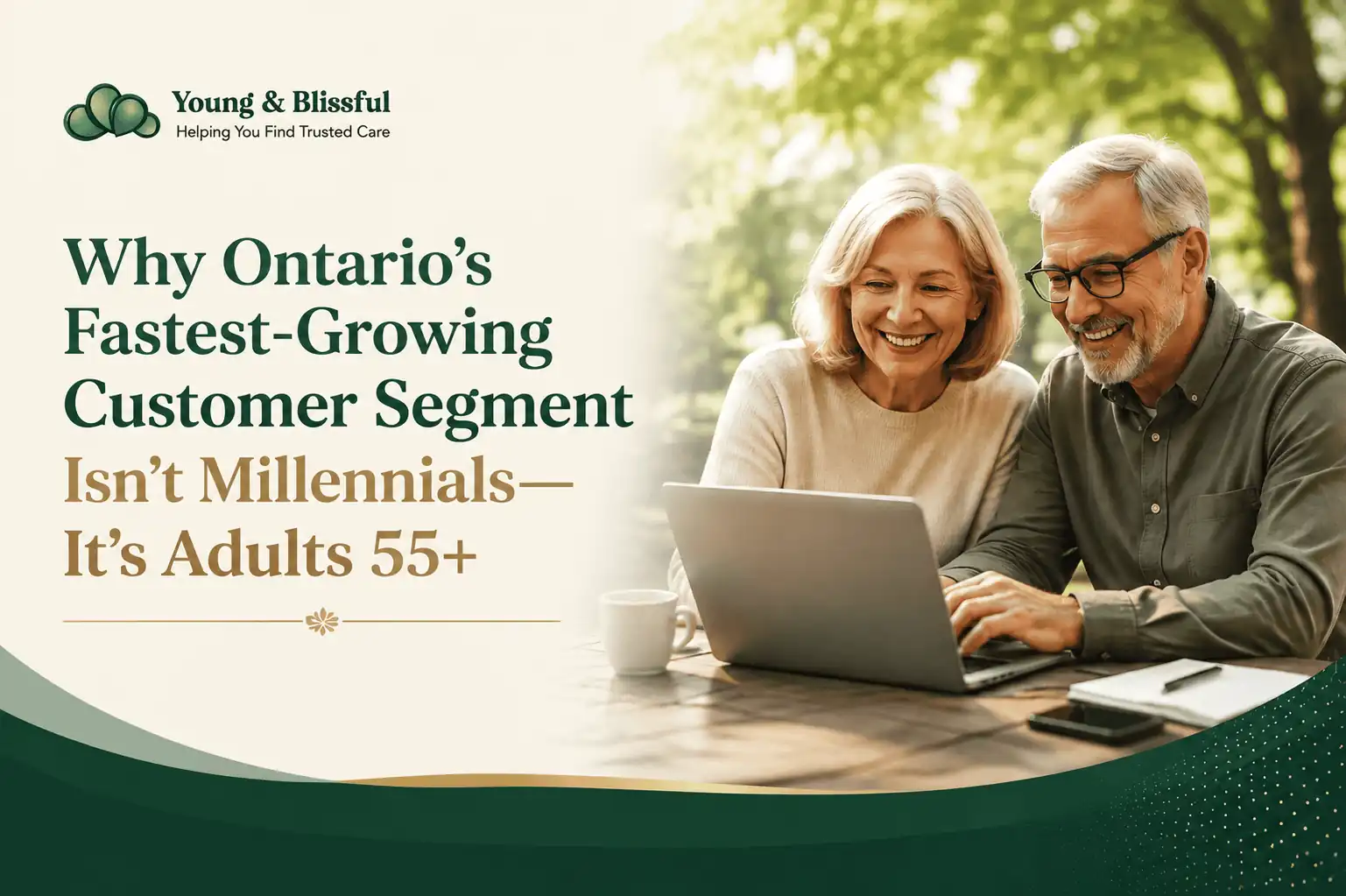
Ontario businesses that still build their growth strategy around younger consumers are missing one of the clearest shifts in the market. Adults 55+ are becoming a more important customer group across Ontario, not only because there are more older adults, but because older adults and their families influence spending across care, housing, transportation, wellness, home services, technology, legal planning, and daily living support.
This matters far beyond senior care. A large portion of the real buying journey often happens when an older adult, a spouse, an adult child, and sometimes a caregiver all play a role in the same decision. That means local businesses need to think differently about trust, communication, accessibility, and how easy they are to compare. For businesses in Ontario, the question is no longer whether adults 55+ matter. The question is whether your business is set up to serve them well.
Quick Answer
- Adults 55+ are becoming a larger share of Ontario’s customer base and influence spending across healthcare, housing, transportation, technology, wellness, and home services.
- Many purchases for older adults are made jointly by seniors, spouses, caregivers, and adult children, which changes how businesses should market, communicate, and build trust.
- Businesses that simplify decision-making, show credibility, and make access easier are more likely to win in Ontario’s aging market.
- The opportunity is not limited to care providers. Local service businesses in many industries can grow by adapting to the needs of older adults and caregiving families.
What does this market shift actually mean?
It means that growth in Ontario is increasingly linked to older adults, caregiving households, and family decision-making. Adults 55+ are not one single group, but they share a few important characteristics that businesses often underestimate. Many have accumulated experience, networks, housing decisions, family responsibilities, and long-term planning needs that influence what they buy and who they trust.
This customer segment also influences far more than direct purchases for “senior” services. An adult child in Toronto may search for transportation support in Ottawa for a parent. A spouse in Durham Region may compare home safety providers, meal support, and caregiver support at the same time. A retired couple may be exploring home modifications, physiotherapy, downsizing help, and technology assistance together. The purchasing context is layered, and businesses that understand that complexity can position themselves much more effectively.
Why millennials are not the only growth story
Millennials remain important consumers, but many businesses over-focus on youth-oriented branding, fast trends, and style while underinvesting in trust, clarity, and service design. Adults 55+ often care less about hype and more about whether a business feels dependable, accessible, and responsive.
That does not mean older adults do not use digital tools. It means their digital expectations are different. They often want pages that are easier to scan, contact details that are easy to find, and service descriptions that answer practical questions quickly. Adult children and caregivers also want to compare options without doing unnecessary detective work.
How older adults and families influence spending
Many purchases connected to aging are high-trust and high-consequence. These decisions can affect safety, stress, independence, mobility, routines, and family time. As a result, the decision process often includes more research, more discussion, and more comparison than a typical low-risk purchase.
That is why older adults and caregiving families influence spending across industries. They may be choosing a home care agency, but they may also need legal planning, transportation, home repairs, accessibility products, hearing care, meal support, counselling, dental care, or relocation help. In many situations, one initial need reveals ten related needs. Businesses that understand the wider journey can create stronger partnerships and referral relationships.
What businesses should change now
First, businesses should review whether their message is easy to understand. If a senior or adult child lands on a website, can they quickly tell who the service is for, what problem it helps with, where it is offered, and what the next step is? If not, friction is already costing leads.
Second, businesses should look at accessibility in a broad sense. Accessibility is not only about ramps or large print. It also includes readable copy, simple navigation, direct contact options, flexible communication, and an intake process that does not overwhelm someone who is already stressed.
Third, businesses should stop treating senior-focused demand as a side market. The 55+ segment is not an afterthought. It is a strategic growth area that deserves its own lens on service design, content, local SEO, staff training, and partnerships.
Common mistakes businesses make
A common mistake is assuming that “senior-friendly” means sounding old-fashioned or overly simplified. What older adults and caregivers actually want is not patronizing content. They want calm, respectful, practical communication.
Another mistake is designing marketing that speaks only to the end user and not the decision circle around them. In reality, a business may need to reassure the senior, answer the adult child’s comparison questions, and show the caregiver how the service reduces strain.
A third mistake is relying on vague language like “we care” or “personalized support” without explaining what that means in practice. Specificity builds trust. Vague language makes comparison harder.
How Young & Blissful fits this shift
Young & Blissful is positioned as an Ontario senior-care marketplace that helps families explore options by category, location, and care need. In a market where comparison and trust matter, a marketplace model can reduce confusion by helping people see relevant service options in one place.
For businesses, this shift also matters because visibility is changing. Families increasingly move between Google, directories, maps, websites, and AI-powered search experiences. Being present where comparison happens can become just as important as having a good service.
Action Steps for Ontario Businesses
A practical first step is to audit your public-facing message through the eyes of a caregiving family. Ask whether a daughter in Mississauga, a spouse in Whitby, or a senior in Ottawa could understand your offer in less than a minute. If the answer is no, the business may be losing qualified interest before the first contact ever happens.
The next step is to review local discoverability. Senior and caregiver searches often begin with location terms, problem-based searches, or “near me” language. Businesses should make sure that their service area, service type, and next step are visible on their website, Google profile, and marketplace listings. Clear local signals can make comparison easier and reduce friction for families making time-sensitive choices.
Finally, businesses should build stronger partnerships with other senior-focused services. A family may begin with one need and quickly uncover several more. A business that becomes known as collaborative, clear, and referral-friendly is more likely to stay visible as the family journey evolves.
How to Compare Providers Before You Contact Them
Families comparing providers often look first at service area, senior experience, responsiveness, and whether the service feels relevant to the real problem. Businesses should make those answers easy to find. If comparison is difficult, trust becomes harder to build.
A simple rule is this: if a caregiver must call just to understand the basics, the business is creating unnecessary effort. Clear descriptions, clear geography, and clear expectations help families shortlist with more confidence.
Provider Checklist
- Is the business easy to understand within the first few seconds of landing on the page?
- Does the website clearly say who the service is for and which Ontario areas are served?
- Can a senior, caregiver, or adult child understand the next step without guessing?
- Is contact information easy to find on both desktop and mobile?
- Are service descriptions practical, specific, and free of vague jargon?
- Does the business show trust signals such as reviews, experience, or relevant credentials where appropriate?
- Can caregivers or adult children be included in planning or first-contact conversations?
- Does the intake process reduce friction instead of adding it?
Related Services to Explore on Young & Blissful
- Caregiver Support: useful when families need guidance, respite, or help navigating complex decisions.
- Home Care & Personal Support: useful when routines, companionship, or day-to-day support are becoming harder to manage.
- Housing, Retirement & Long-Term Care: useful when the family is considering a move or comparing living options.
- Daily Living & Lifestyle Support: useful when errands, meals, home tasks, or social routines are becoming difficult.
FAQs
Why are adults 55+ such an important market in Ontario?
Adults 55+ represent a growing group of consumers, caregivers, homeowners, retirees, and decision-makers. They often influence spending not only for themselves, but also for spouses, parents, and families.
Does this only matter for healthcare businesses?
No. The aging market affects housing, transportation, legal services, financial planning, home maintenance, technology, wellness, and many other local businesses.
Who makes senior-related buying decisions?
In many cases, the decision is shared. A senior may choose the service, while an adult child, spouse, or caregiver compares providers, asks questions, and helps coordinate the next step.
What matters most to older adults and caregivers?
Clear communication, trust, accessibility, location, responsiveness, and confidence that the business understands senior needs all matter. Families also look for businesses that reduce confusion and help them compare options.
How can a business start adapting to this market?
Start by reviewing your website, intake process, service descriptions, and customer experience. If your business is hard to understand or difficult to contact, families may move on quickly.
Does a business need to rebrand completely to serve seniors?
Usually not. Most businesses need clearer language, better accessibility, stronger credibility signals, and a more thoughtful experience for both seniors and caregivers.
Key Takeaways
- The Ontario aging market affects more than healthcare and should be treated as a strategic business opportunity.
- Seniors rarely make decisions in isolation. Caregivers, spouses, and adult children often influence the final choice.
- Trust, accessibility, clarity, and ease of comparison matter strongly in senior-related decision-making.
- Businesses that reduce friction often improve both customer experience and conversion performance.
- Young & Blissful can act as a marketplace starting point for families comparing local senior-focused services across Ontario.
Conclusion + Soft CTA
Ontario businesses do not need to guess where new demand is coming from. Adults 55+, caregiving households, and families navigating later-life decisions are already shaping the market. Businesses that communicate clearly, build trust, and make comparison easier will be better positioned for long-term growth. If your organization serves older adults, caregivers, or families in Ontario, Young & Blissful can help people explore relevant services by category and location with more clarity.