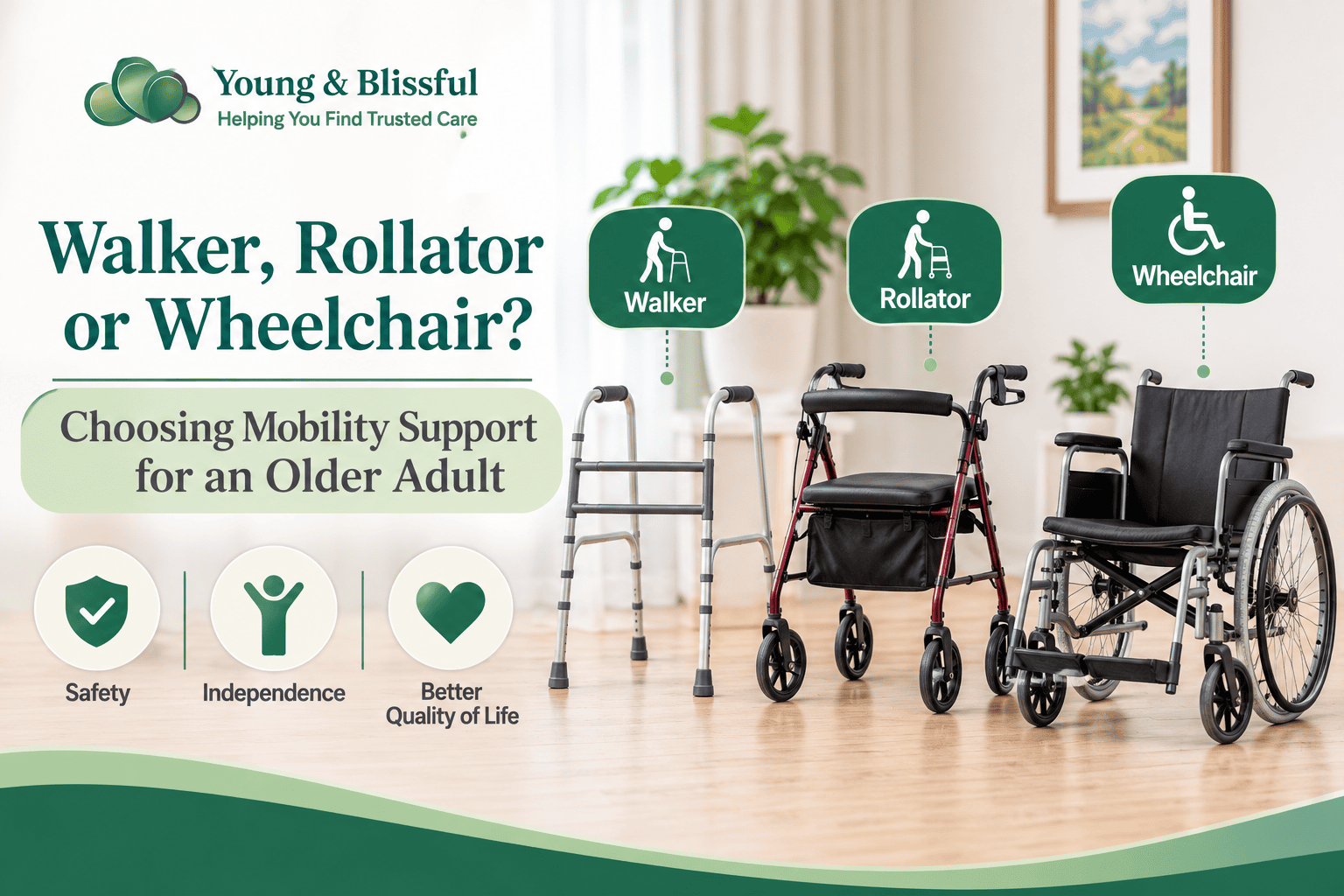
A walker that looks sturdy in a store can feel awkward in a narrow hallway. A rollator with a seat may be useful for someone who tires on long outings, yet be unsuitable for a person who needs substantial support with weight-bearing. A wheelchair can make longer journeys possible, but it still has to fit the user, the doorway and the transport plan. Choosing a mobility aid for an older adult is not simply a shopping decision. It should start with how the person moves, where they need to go and what a qualified professional recommends.
Quick answer: what is the difference?
- Standard walker: Usually a rigid frame; may suit certain people who need steady support, but lifting it can be difficult.
- Wheeled walker or rollator: Uses wheels; rollators often have brakes and a seat, but safe use requires suitable balance, hand function and training.
- Wheelchair: Supports seated mobility when walking is limited or unsafe; manual and powered options differ significantly.
- Best choice: The aid that fits the person’s assessed needs, environment and safe-use abilities, not whichever model receives the best online reviews.
Start with a real-life mobility problem
What is difficult today? Getting from bedroom to washroom? Waiting in a grocery line? Walking from the car to a clinic? Moving across uneven pavement? Some seniors need support on long outings but can move around their home without equipment. Others have trouble with transfers or standing even briefly. There is no single device that solves all of these situations.
Describe the practical goal: “I’d like to walk to the mailbox,” or “I want to attend my granddaughter’s graduation without worrying about the long distance.” That goal helps a physiotherapist or occupational therapist choose an appropriate assessment and discuss training. It also prevents a family from purchasing several aids in frustration while the underlying difficulty remains unresolved.
What is a walker?
A traditional walker is a support frame that may have no wheels or wheels on selected legs. Different designs suit different people. Someone must be able to control it correctly while moving, turning and navigating tight spaces. A non-wheeled walker may require lifting or repositioning, which is not practical for everyone. A wheeled walking aid may move more easily but introduces its own control requirements.
The correct height, grip and walking pattern matter. A device that is too tall or too short can affect comfort and posture. Ask a professional to check fit, particularly if the senior has shoulder pain, weakness, asymmetry or difficulty following instructions. Avoid assuming that a walker is automatically safer than a cane; the best choice depends on assessment.
What is a rollator?
A rollator commonly has three or four wheels and may include hand brakes, a storage bag and a seat. The seat can be useful during outings, but it is not a substitute for a stable chair in every setting. Brakes must be usable and understood. Someone may be able to grip the handles yet struggle to coordinate braking on slopes, curbs or during transfers.
Ask about indoor versus outdoor wheels, terrain, storage, weight limits, transport in a vehicle and what happens when the person gets tired. Practice turning and using the brakes with guidance. If a device encourages someone to move faster than they can safely control, it is not the right match simply because it rolls smoothly.
When might a wheelchair be useful?
A wheelchair may support participation when walking far enough is not realistic. That does not always mean someone must stop walking altogether. Some people use a wheelchair for outings while maintaining appropriate mobility activities at home. A manual chair requires either sufficient upper-body ability to propel or a caregiver who can assist. A powered wheelchair has additional requirements for operation, storage, charging, safety and transportation.
Fit extends beyond seat width. Positioning, pressure management, transfers, armrests, foot support and transport requirements matter. For people who spend long periods seated, professional assessment is particularly important. The easiest chair to fold is not necessarily the safest chair to use for many hours.
Compare aids by task, not advertising claims
| Everyday situation | Assessment considerations |
| Short indoor walks | Balance, turning space, flooring, transfers |
| Longer outings | Endurance, rest opportunities, terrain and caregiver support |
| Sloped sidewalk | Brake control, footwear and ability to manage gradients |
| Getting into a car | Folding dimensions, transfer ability, safe transport |
| Narrow bathroom | Door clearance, turning, grab bars and transfer setup |
| Seated mobility | Positioning, propulsion, skin protection and transport security |
This comparison is not a prescription chart. A PT or OT can assess both the person and the environment before recommending a particular device.
Can Ontario help pay for mobility equipment?
Ontario’s Assistive Devices Program (ADP) helps eligible residents with long-term physical disabilities pay for certain customized devices. The province says the program generally requires a valid Ontario health card and a need for a device for at least six months, with device-specific clinical requirements. For approved mobility equipment, the program commonly covers 75% of the approved price, with different arrangements for some social assistance recipients.
Not every item is eligible. Ontario’s mobility aids page lists coverage for certain wheelchairs and adult wheeled walkers, while standard walking canes, non-wheeled walkers, wheelchair ramps and some other items are not covered under that category. The ADP also does not generally cover grab bars, stair lifts or home renovations. Confirm authorization and the registered vendor process before purchasing. Buying something first and applying later may leave the family with an unreimbursable bill.
Official resource: Ontario mobility aids.
Questions to ask before buying or renting
Ask why the device is being recommended, who will teach safe use and how the fit will be checked. Ask what the senior will do on stairs or in the bathroom, since the device may not be usable everywhere. Confirm return, rental, repair, warranty and replacement policies. If the equipment is used, ask about brake condition, structural damage, correct sizing and available service records.
Families should also think about caregivers. Can the person helping lift a chair into the car do so safely? Does the aid fit through the usual entrances? Is there a place to store it without blocking a hallway? A trial in the actual environment can be worth more than a long specification sheet.
Common mistakes
Ordering a rollator because it looks less medical, or a wheelchair because it is the quickest way to get to an appointment, may miss the user’s functional goals. Other mistakes include choosing by height alone, not testing brakes, assuming all accessories are funded, overlooking safe transport and never revisiting the fit as needs change. If there is a recent fall, sudden weakness or acute change in walking, seek appropriate medical assessment rather than treating equipment as a substitute.
Family and provider checklist
- What tasks are difficult, and what does the older adult want to do more independently?
- Has a PT or OT assessed mobility, transfers and appropriate equipment?
- Are fit, brakes, wheels and weight limits suitable?
- Will it work in the person’s home, vehicle and common destinations?
- What training will the user and caregivers receive?
- Is there an ADP route, and must approval happen before purchase?
- What happens if the device needs repairs or the person’s needs change?
Frequently asked questions
Is a rollator safer than a walker?
Neither is automatically safer for everyone. The user’s balance, strength, judgment, hand control and environment determine the appropriate choice.
Can a rollator be used as a wheelchair?
Most rollators are not designed to transport someone while seated. Follow the manufacturer’s instructions and obtain professional advice about the correct device.
Does Ontario pay for wheelchairs?
ADP may fund eligible approved mobility devices, including certain wheelchairs, for qualifying people. Assessment, program rules and registered vendor processes apply.
Are grab bars covered by ADP?
Ontario’s ADP lists grab bars among items it does not cover. Other local or private assistance programs may have different rules.
Should an older adult rent or buy a wheelchair?
That depends on duration, fit, financing, repairs and expected changes in need. A short-term rental can be worth discussing, but not every rental is funded by ADP.
Who can help select mobility equipment?
A physiotherapist or occupational therapist can assess relevant needs and may assist with device selection or funding processes within their role.
When should mobility needs be reassessed?
Reassessment can be important after changes in strength, falls, surgery, discomfort or home circumstances. A device that fit last year may no longer be suitable.
Key takeaways
Good mobility support makes a specific daily activity more manageable. A walker, rollator and wheelchair do different jobs, and safe fitting matters as much as features. Check Ontario ADP eligibility before buying, and choose equipment with the older adult’s goals and environment in mind.
Explore options: Find mobility and accessibility providers through Young & Blissful. Confirm availability, assessment requirements, prices and equipment funding directly with the provider.
*Educational information only. Do not use this guide as an individual mobility-device prescription.*
References
- Government of Ontario, Assistive Devices Program.
- Government of Ontario, Mobility aids.
- College of Occupational Therapists of Ontario, Working with an OT.